
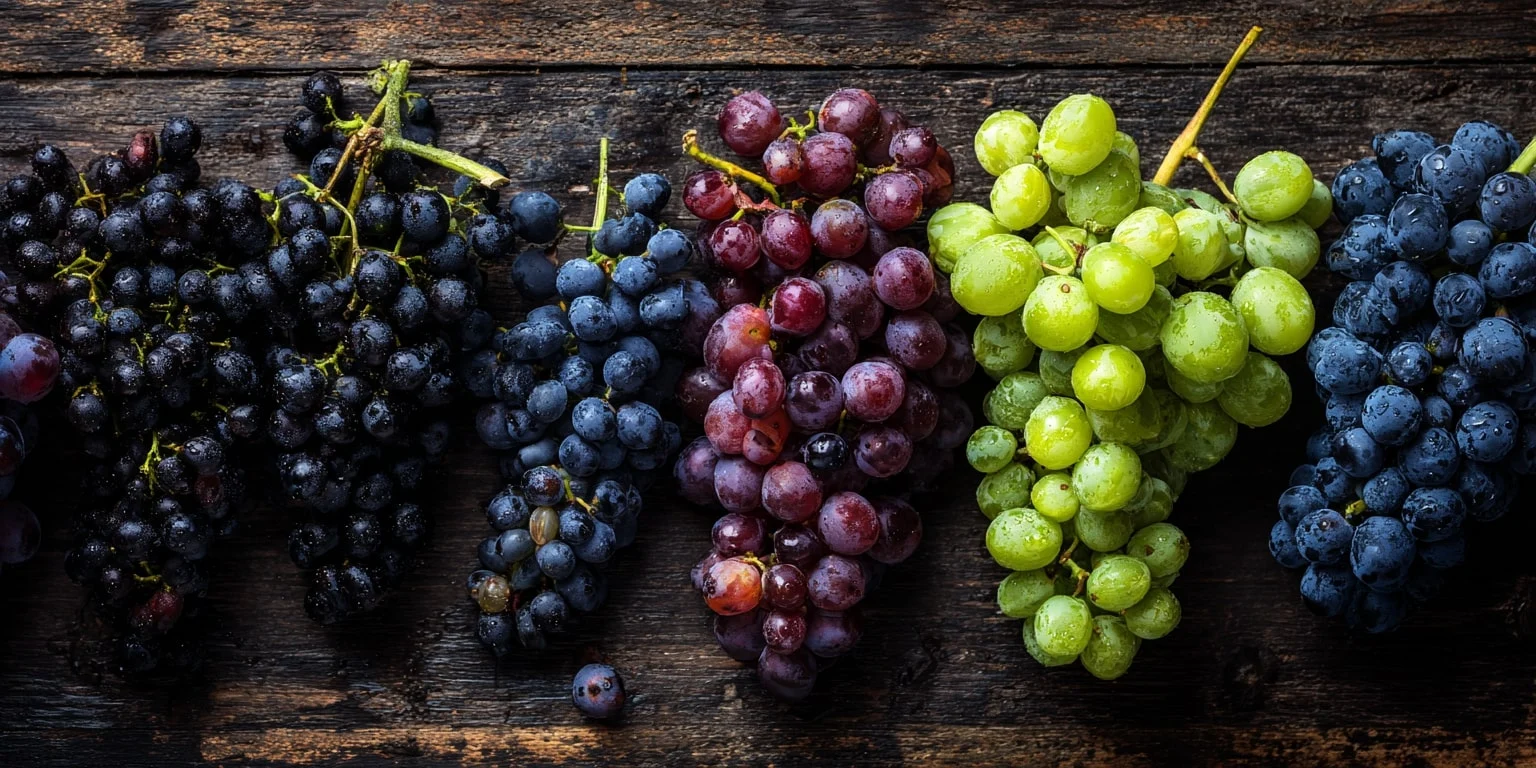
Use this directory to recognize grape names on a wine label and find a style to try. Linked names lead to our detailed profiles; the other entries are short reference notes. Regions are examples, not a complete list of where a grape grows. A grape name suggests a range of styles, while climate, producer and winemaking shape the bottle you buy.
This is a directory of names rather than a count of distinct varieties: regional synonyms such as Mourvèdre/Monastrell and Vermentino/Vermentinu appear separately. Muscat and Malvasia refer to grape families. Dark-skinned grapes can also make rosé or white wine; the sections below reflect their usual use.
Choose a grape guide by the style you want
Start with the kind of bottle you want to drink, then use the grape profile to ask better questions at a US wine shop. Grape names describe a range of possibilities; they do not fix sweetness, oak level or price.
- A white wine with little obvious oak: compare Sauvignon Blanc with the unoaked styles in our Chardonnay guide. Ask about the particular bottle rather than assuming every California Chardonnay tastes buttery.
- A fuller white for creamy food: read the oaked Chardonnay section, then check whether the producer describes a rich or restrained style. Oak and sweetness are different questions.
- A red to compare with Pinot Noir: our Oregon and California Pinot Noir guide gives a starting point. For a different structure, explore Merlot from Washington, Napa and Bordeaux.
- A red for a substantial meal: compare Cabernet Sauvignon, Malbec and Grenache. Match the bottle to the sauce and seasoning, not just the meat.
- A question about sweetness: check the producer's notes. Our Riesling guide explains why a grape name alone cannot tell you whether a wine is dry.
For a useful comparison, choose two bottles in a similar price range and taste them with the same dish. Note acidity, tannin, body and oak separately. If one is sweet and the other dry, the result reflects winemaking choices as well as the grapes.
These are editorial starting points, not reports of a new tasting. Use the food pairing guide to narrow the choice and the serving temperature guide before opening your bottles.
Red Grape Varieties
- Cabernet Sauvignon. Structured reds from Bordeaux, Napa Valley and many other regions
- Merlot. Plum-fruited reds, notably in Bordeaux blends
- Pinot Noir. Red Burgundy, Oregon and other cool-climate regions
- Syrah. Northern Rhône reds; also known as Shiraz
- Grenache. Southern Rhône blends and Spanish Garnacha wines
- Malbec. Red wines from Cahors and Argentina
- Tempranillo. A key red grape in Rioja and Ribera del Duero
- Sangiovese. Tuscan reds including Chianti and Brunello di Montalcino
- Nebbiolo. Piedmont reds including Barolo and Barbaresco
- Gamay. The fruity grape of Beaujolais
- Mourvèdre. The tannic grape of Bandol
- Carignan. Southern French and Spanish red wines
- Cinsault. The grape of Provence rosés
- Tibouren. A grape used in Provence rosés
- Tannat. Firmly tannic reds from Madiran and Uruguay
- Petit Verdot. A red blending grape in Bordeaux and elsewhere
- Zinfandel. California reds; the same grape as Primitivo
- Pinot Meunier. A dark-skinned grape widely used in Champagne
- Carménère. A Bordeaux variety now closely associated with Chile
- Aglianico. Structured southern Italian reds, including Taurasi
- Nero d'Avola. A widely grown Sicilian red grape
- Negroamaro. Reds and rosés from Puglia, especially Salento
- Barbera. Piedmont reds, including Barbera d'Asti and Barbera d'Alba
- Corvina. The grape of Amarone and Valpolicella
- Dolcetto. The Piedmontese red grape (Dogliani DOCG)
- Primitivo. The name used in Puglia for the same grape as Zinfandel
- Montepulciano. A red grape associated with Abruzzo
- Sagrantino. Firmly tannic reds from Montefalco in Umbria
- Lagrein. Red wines from Alto Adige in northern Italy
- Nerello Mascalese. The volcanic grape of Etna (Sicily)
- Nielluccio. The Corsican grape of Patrimonio
- Négrette. The floral grape of Fronton (Southwest France)
- Aramon. A traditional red grape of Languedoc
- Touriga Nacional. Portuguese reds and Port blends
- Baga. Red wines from Bairrada in Portugal
- Mencía. Red wines from Bierzo and Ribeira Sacra
- Monastrell. The powerful Spanish grape of Jumilla (synonym of Mourvèdre)
- Graciano. An aromatic red blending grape in Rioja
- Xinomavro. Structured Greek reds, notably from Naoussa
- Blaufränkisch. Red wines from Austria, including Burgenland
- Zweigelt. Austria's flagship red grape
- Dornfelder. Dark-colored German reds, including Pfalz and Rheinhessen
- Petite Sirah. Deeply colored, often tannic California reds; also called Durif
- Mondeuse. The red grape of Savoie (Arbin AOC)
- Pinotage. South Africa's signature grape (Stellenbosch, Cape Blend)
- Frappato. Light Sicilian red (Cerasuolo di Vittoria DOCG, Vittoria)
- Trousseau. The rare grape of the Jura
White Grape Varieties
- Chardonnay. Burgundy, Champagne and many still wines worldwide
- Sauvignon Blanc. The aromatic grape of the Loire and Marlborough
- Riesling. Dry to sweet wines, notably from Germany and Alsace
- Gewurztraminer. Floral, spicy wines with a distinctive lychee character
- Viognier. Aromatic whites from Condrieu and other regions
- Chenin Blanc. Dry, sweet and sparkling wines from the Loire and beyond
- Pinot Gris. Alsace whites; also called Pinot Grigio in Italy
- Pinot Blanc. The white grape of Alsace (Weißburgunder)
- Sémillon. The grape of Sauternes and Graves
- Marsanne. The white grape of the Northern Rhône
- Roussanne. A white blending grape in the Rhône Valley
- Muscat. A family of aromatic grapes used for dry and sweet wines
- Aligoté. A white grape of Burgundy, including Bouzeron
- Melon de Bourgogne. The grape of Muscadet
- Savagnin. The grape of Vin Jaune (Jura)
- Picpoul. Fresh white wines, notably Picpoul de Pinet
- Vermentino. The Mediterranean white grape
- Vermentinu. The Corsican name for Vermentino
- Colombard. The white of Gascony (IGP Côtes de Gascogne)
- Albariño. The Atlantic white of Galicia (Rías Baixas)
- Verdejo. White wines from Rueda in Spain
- Garnacha Blanca. The Spanish name for Grenache Blanc, notably in Terra Alta
- Grenache Gris. The gray grape of Collioure and Banyuls
- Grenache Blanc. White wines and blends in the southern Rhône and Roussillon
- Glera (Prosecco). The grape of Prosecco (Veneto, Conegliano Valdobbiadene)
- Garganega. White grape of Soave (Veneto, Soave Classico DOC)
- Grillo. White grape of Sicily (Sicilia DOC, Marsala)
- Catarratto. A white grape widely grown in Sicily
- Malvasia. Mediterranean family (Lipari DOC, Istriana, Madeira Malmsey)
- Ugni Blanc. Used for wine and brandy; known as Trebbiano Toscano in Italy
- Pecorino. White of the Marche (Offida DOCG, Abruzzo DOC)
- Assyrtiko. The volcanic white of Santorini
- Grüner Veltliner. Austrian whites from regions such as Wachau and Kamptal
- Furmint. The volcanic white of Tokaj (Hungary)
- Falanghina. The Campanian white (Sannio DOC)
- Fiano. A Campanian white grape, including Fiano di Avellino DOCG
- Folle Blanche. Used for wine and brandy in western France
- Jacquère. The white of Savoie (Apremont, Abymes)
- Torrontés. Argentina's flagship aromatic white
For the Italian names, distinguish grape and place: Fiano is the grape; Fiano di Avellino DOCG is an appellation. Montepulciano is a grape, while Vino Nobile di Montepulciano is a different wine named after a town. UC Davis documents the shared genetic identity of Zinfandel and Primitivo; this does not mean every wine made from them tastes the same.
Explore the guides
Red wine, white wine and food and wine pairing.
Practical guides: wine serving temperatures, how to decant wine and opening wine without a corkscrew.